Centrifuge Lock Mechanism

Precision Motion for Centrifuge Locking and Safety Systems

In modern laboratory centrifuges, miniature motors and gearboxes ensure safe, reliable, and precise lid locking mechanisms.
 
Rotalink’s motion systems provide the torque, control, and quiet operation required to protect users, maintain instrument integrity, and support consistent laboratory performance. 
Rotalink | Centrifuge Lock Mechanism 0
Industry Challenges

Centrifuge locking systems must combine compact design, safety assurance, and mechanical reliability while maintaining low noise levels.

  • Safety interlock reliability
    Ensuring the lid cannot open during operation.
  • High torque in limited space
    Achieving strong mechanical engagement within small bench‑top instruments.
  • Smooth engagement
    Preventing sudden or jerky locking motion. 
  • Noise reduction
    Maintaining quiet operation in laboratory environments.
  • Position stability
    Retaining lock engagement without continuous motor power.

How Motion Technology Supports Centrifuge Locking Systems

Rotalink’s miniature motors and gearboxes deliver controlled torque and precision motion for centrifuge safety interlocks.  
Our motion solutions provide:
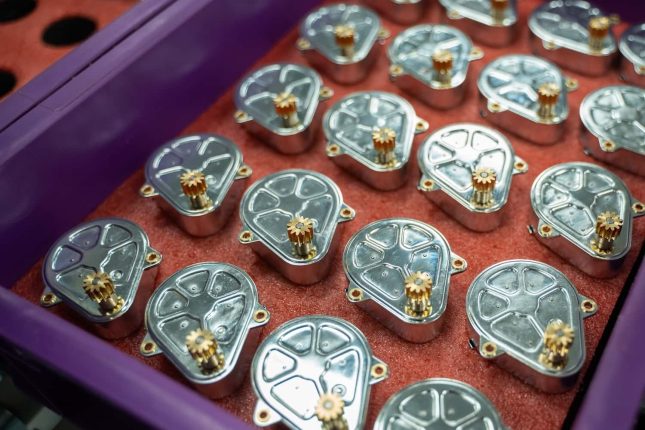
  • Torque amplification
    Allowing small motors to control powerful locking mechanisms.
  • Controlled engagement
    Ensuring smooth, precise lock movement.
  • Low noise output
    Achieved through speed reduction and fine gear design.
  • Compact, reliable integration
    Fitting safely within small centrifuge housings.
  • Position retention
    Enabling the lock to remain engaged even when powered down.
Rotalink | Centrifuge Lock Mechanism 1

Applications of Miniature Motors and Gearboxes
in Centrifuge Lock Mechanisms

Rotalink | Centrifuge Lock Mechanism 2

Lid Locking and Unlocking (Safety Interlock)

  • Purpose: Prevents centrifuge lids from opening during high‑speed operation.
  • Gearbox Role: Provides torque for reliable mechanical locking through DC or stepper motor drive systems.
  • Why Gearbox is Needed: Amplifies torque to move locking cams or bolts securely.
Rotalink | Centrifuge Lock Mechanism 3

Controlled Engagement and Disengagement

  • Purpose: Allows smooth, precise motion of locking pins or cams.
  • Gearbox Role: Reduces speed and increases torque for delicate, accurate engagement.
  • Why Gearbox is Needed: Minimises mechanical shock and extends component life.
Rotalink | Centrifuge Lock Mechanism 4

Torque Multiplication

  • Purpose: Enables small motors to move robust locking mechanisms efficiently.
  • Benefit Supports compact bench‑top centrifuge designs without high‑power motors.
Rotalink | Centrifuge Lock Mechanism 5

Position Holding

  • Purpose: Maintains lock engagement even when power is off.
  • Gearbox Role: High‑ratio gearboxes prevent backdriving, holding mechanical position.
  • Benefit: Improves safety and energy efficiency.
Rotalink | Centrifuge Lock Mechanism 6

Quiet Operation

  • Purpose: Reduces operational noise in laboratory environments.
  • Gearbox Role: Slows motor speed and smooths mechanical motion for low‑noise performance.

Typical Gearbox Types Used in Centrifuge Lock Mechanisms

  • Planetary Gearboxes:
    Compact and high‑torque, ideal for high‑end laboratory instruments.
  • Worm Gearboxes:
    Offer self‑locking capability to prevent backdriving and maintain position.
  • Spur Gearboxes:
    Provide efficient, cost‑effective torque delivery for larger devices with more space.
Rotalink | Centrifuge Lock Mechanism 7

Broader Laboratory Instrument Applications

Beyond centrifuge locking systems, Rotalink’s miniature motors and gearboxes are used across a variety of laboratory automation and analytical systems, including:


  • Pipetting robots:
    Delivering precise, linear motion.
  • Sample handlers and loaders:
    Providing rotary or linear tray motion. 
  • Valves in fluidic systems:
    Enabling accurate torque control for opening and closing.
  • Microscope stage positioning:
    Achieving ultra‑fine, repeatable movement.

Why Choose Rotalink for Laboratory Instrumentation?

  • Compact, efficient motion systems
    Ideal for small laboratory instruments.
  • Quiet, precision gearboxes
    Designed for low vibration and consistent performance.
  • High torque density
    Supporting powerful actuation in limited space.
  • Long‑life reliability
    Engineered for continuous, repetitive use.
  • Custom design expertise
    Tailored to your locking or motion control application.